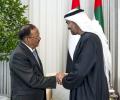
India is the only significant power that all parties trust, or at least do not distrust, notes former defence secretary Ajay Kumar.

The UN Security Council, with India's support, has adopted a resolution condemning Iran's attacks on Gulf Cooperation Council countries and Jordan, demanding an immediate cessation of hostilities and denouncing threats to the Strait of Hormuz.

'If movement remains stalled for three to four months, more than 300,000 recruitments from India could be affected.'

The UN Security Council will vote on a Bahrain-proposed resolution regarding the Strait of Hormuz, aiming to ensure freedom of navigation amid concerns and opposition from some members.

External Affairs Minister S Jaishankar discussed the West Asia conflict's impact on the global economy, particularly energy security, with US Secretary of State Marco Rubio. He also engaged with GCC ambassadors and his Sri Lankan and German counterparts on the same issue.

The Ministry of External Affairs (MEA) has stated that Prime Minister Narendra Modi and External Affairs Minister S Jaishankar are actively engaged with world leaders to promote dialogue and diplomacy for peace in West Asia, while also ensuring the safety and well-being of the Indian community in the region.

The broader conflict in West Asia, the largest international market for Indian carriers, has forced a sharp reduction in daily flights relative to the summer schedule.

Iran was the chance to arrange a concert of nations, to actually be a Vishwaguru. Instead, we are watching from the sidelines as Pakistan, the same country that is apparently still at war with Afghanistan, hosts talks between US-Israel and Iran. The irony is hard to miss, points out Amberish K Diwanji.
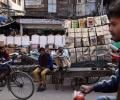
Moody's Ratings has downgraded India's growth forecast for financial year 2026-27 (FY27) to 6 per cent from 6.8 per cent, attributing the revision to weaker consumption and industrial activity, elevated energy prices, and rising input costs stemming from the West Asia conflict.

Fitch Ratings on Friday said persistently higher oil prices could cause India's retail inflation to rise faster than the expected gradual pace, and lead to a slowdown in economic growth in the first half of financial year 2026-27 (FY27).

'In a volatile global market, India is pursuing a low-risk, low-return policy, akin to a SIP -- slow, steady investment.' 'Pakistan is following a high-risk, high-return policy.'

In a move which could pave the way for a Free Trade Agreement between India and the Gulf Cooperation Council, both the partners have concluded negotiations for a Framework Agreement expected to be inked soon.

Russian President Vladimir Putin and Chinese President Xi Jinping have reaffirmed their commitment to dismantling global hegemonism and building a 'multipolar world' during high-level talks in Beijing.

Some of these nations are India's biggest export market. India is also dependent on these countries to meet its energy needs.
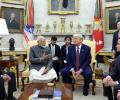
Prime Minister Narendra Modi and US President Donald Trump discussed the Middle East crisis, with a focus on the Strait of Hormuz.

With Gulf countries emerging as popular destinations for Indian weddings and pre-wedding shoots, the March-April season had seen a flurry of bookings.

MEA data show that the number of Indian students in the UAE in 2025 was 253,832, just behind the United States with 255,447 students, and Canada being on top at 427,085.

By appearing to privilege ideological affinity over strategic balance, India risks eroding the trust painstakingly built across West Asia. Once the perception takes hold that India's friendship is conditional and transactional, rebuilding credibility will be difficult, warns Amberish K Diwanji.

Next week's three-nation foreign tour of Prime Minister Narendra Modi will see India and Oman sign a free trade deal. The visit will also pave the way for agreements with Ethiopia and Jordan to increase India's bilateral trade and investments.

While investors would focus on the results and guidance for the third quarter of financial year 2025-26 (Q3FY26) in the normal course of business, the US-Israeli attack on Iran and the latter's retaliation at Gulf allies of the US has forced them to weigh the consequences of the event.

'The West Asia or the Gulf crisis has shown that what we develop as national infrastructure when things are not as bad as they could be, we forget to plan for adversities.'

India may adopt a "calibrated" and a "step-by-step" approach to easing norms on investments originating from China, Union Commerce and Industry Minister Piyush Goyal said on Tuesday. He was in a conversation with A K Bhattacharya on Day 1 of Business Standard's two-day annual event, Manthan 2026. The minister said foreign direct investment (FDI) from China was certainly not "banned", but it goes through an approval process. "The government's approach at the moment is to accelerate the approval process."
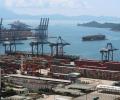
With the Iran war escalating sharply and crisis deepening in the global energy market, India on Monday unveiled a coordinated plan to support exporters and shippers caught in the fallout.

'There are very few issues and a political call needs to be taken about some of them.'

FDI inflows into India are expected to register robust growth in 2026, supported by strong macroeconomic fundamentals, big-ticket investment announcements, sustained efforts to improve the ease of doing business, and a new generation of investment-linked trade pacts.

The intriguing bit is that Trump is likely to attend the talks in Islamabad this weekend -- if he does, it will be the clearest signal yet that the US is ready to exit the war with some sort of win to show, since he cannot afford to go for the talks and return empty-handed, notes Prem Panicker in his must read blog on the Iran War
Bharathi Sihag, joint secretary at the ministry of commerce of India, told Abu Dhabi's National newspaper that the date had almost been set: "We will be meeting very soon, next month or October." The FTA between India and Gulf Cooperation Council has been delayed, ever since the first round held in March 2006, due to administrative reasons as the same set of officials are involved in talks with EU and Korea over similar trade pacts.

By all available indications, the White House drafted a face-saving note and handed it, ready-made, to Islamabad. Pakistani Prime Minister Shehbaz Sharif was supposed to then post it in the guise of a plea urging Trump to extend the deadline by two weeks 'to allow diplomacy to run its course'. Trump would then graciously accept Pakistan's 'request' and declare a ceasefire. Sharif dutifully posted the message on X. Except that he, or whoever was handling the account, forgot to delete the tell-tale first line visible in the edit history: 'Draft - Pakistan's PM Message on X'. Prem Panicker's must read blog on the Iran War.
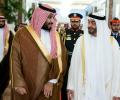
What began as a mentor-protege relationship between UAE President Mohammed bin Zayed and Saudi Crown Prince Mohammed bin Salman has now evolved into a broader contest over influence, strategy, and leadership in the Middle East, points out Asif Ullah Khan.

'Despite the large number of missiles and drones we have already launched, we still possess reserves and missile cities whose doors have not yet been opened,' says Iran's Consul-General Saeid Reza Mosayeb Motlagh.
India is vigorously pursuing for a free trade agreement with Gulf countries, Finance Minister P Chidambaram said on Monday.
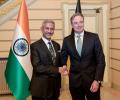
The era where nations thrived through rigid alignments is giving way to an age where the connective State defines power. For India, that era has arrived, points out Dr Nishakant Ojha.

During the discussions attended by Simon Williams, Chief Economist at HSBC, Chirag Shah, Head of Strategy and Corporate Planning at DIFC Authority, and Yousef Bazian, Head of Corporate Finance at PwC in the Middle East, a consensus emerged that the Gulf region has achieved considerable non-oil economic growth.
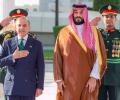
'Saudi-Pak defence pact is to anchor the defence and security of Saudi Arabia and not Pakistan, per se, with Islamabad being the junior partner.'
The four million expatriate Indians in the six Gulf Cooperation Council states remit an incredible $5 billion annually, a study shows.

'When global politics has some intervention on the core software one uses, and if you are cut off from your own data in critical workflows, sovereignty is no longer optional. It becomes a necessity.'
Gulf nations have postponed the six-year residency cap on foreign unskilled workers.
Investments from the Gulf Cooperation Council (GCC) countries to India remain negligible relative to trade flows and represent just a small percentage of total FDI from the region to the world, says a report.

Hospital chain Aster DM Healthcare's plans to sell its Gulf business may run into rough weather with voting advisory firm Institutional Investor Advisory Services (IiAS) raising concerns over the transaction. Recommending an 'against' vote on the resolution, IiAS has said there is no clarity on how Aster DM will utilise the proceeds that it will obtain by selling the unit, which contributes to bulk of its revenues. In November, Aster DM had announced its plans to sell its wholly-owned subsidiary Affinity Holdings, which conducts business in the Gulf Cooperation Council (GCC) region, to Alpha GCC for $1 billion.
 © 2026 Rediff.com - Advertise with us - Disclaimer - Privacy Policy - Sitemap - Feedback - About us - Terms of use - Grievances